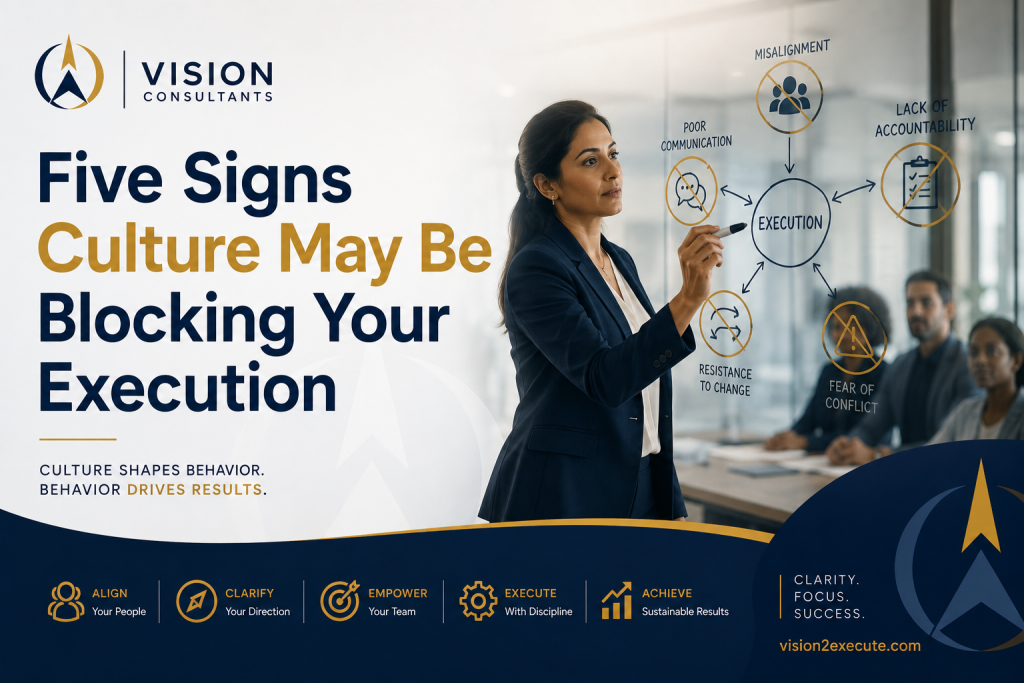
Your Strategy Isn’t Failing. Your Culture May Be.
Why Culture Is One of the Most Overlooked Drivers of Business Execution
You have the plan.
The goals have been communicated.
Responsibilities have been assigned.
The meetings are on the calendar.
Everyone knows what needs to happen.
And yet…
Deadlines keep slipping.
Accountability feels inconsistent.
Problems aren’t raised until they become emergencies.
Employees wait for leadership to make decisions.
Departments operate in silos.
The same issues keep appearing in meeting after meeting.
And leadership is beginning to wonder:
Why aren’t we executing?
The instinct is often to blame the plan.
Maybe we need a better strategy.
A new process.
Different software.
More meetings.
Another manager.
More training.
Sometimes those things are necessary.
But before changing the strategy, there is another question worth asking:
Does your culture actually support the behaviors required to execute it?
At Vision Consultants, we believe execution isn’t simply a strategic challenge.
It’s an organizational one.
And one of the most powerful—and frequently underestimated—forces affecting execution is culture.
Culture Isn’t What You Put on the Wall
Ask a leadership team to describe its culture and you’ll often hear words like:
Integrity.
Teamwork.
Excellence.
Innovation.
Customer First.
Those may be important values.
But they don’t necessarily describe the company’s actual culture.
Culture is what happens after the meeting.
It’s how employees behave when leadership isn’t watching.
It’s whether someone raises a problem or hides it.
It’s whether a missed commitment triggers accountability or another excuse.
It’s whether employees are empowered to make decisions or conditioned to wait for approval.
It’s whether departments collaborate or protect their territory.
It’s whether leaders address poor performance or tolerate it because having the difficult conversation feels uncomfortable.
Your stated values describe the culture you want.
Your organization’s repeated behaviors reveal the culture you actually have.
And that culture either accelerates execution—or quietly works against it.
The Strategy–Culture Gap
Imagine a leadership team establishes an aggressive growth strategy.
The strategy requires employees to make decisions faster, collaborate across departments, identify problems earlier, and take greater ownership of results.
On paper, the strategy makes perfect sense.
But the existing culture tells employees something different.
“Don’t make a decision without approval.”
“Stay in your lane.”
“Don’t bring leadership bad news.”
“We’ve always done it this way.”
“That’s not my responsibility.”
Now the organization has a problem.
Leadership is asking for one set of behaviors while the culture rewards another.
And culture usually wins.
This is the strategy–culture gap.
Organizations can spend enormous amounts of time developing strategies that their existing culture is simply not equipped to execute.
Five Signs Culture May Be Blocking Your Execution
You may not have a strategy problem if these patterns sound familiar.
1. Everything Comes Back to the Owner
Your employees are capable, but decisions continue moving upward.
People ask permission instead of exercising ownership.
Leadership becomes the bottleneck.
And eventually, the owner begins saying:
“Why do I have to make every decision around here?”
The answer may not be the employees.
The organization may have unintentionally created a culture where making the wrong decision feels more dangerous than making no decision.
2. Accountability Depends on the Person
One employee misses a deadline and nothing happens.
Another does the same thing and is immediately questioned.
High performers quietly compensate for weaker performers.
Commitments become negotiable.
Over time, employees learn something important:
What leadership tolerates becomes part of the culture.
And inconsistent accountability eventually produces inconsistent execution.
3. Problems Surface Too Late
Healthy execution cultures make problems visible early.
Unhealthy ones often hide them.
Employees may fear being blamed.
Managers may want to appear in control.
Teams may avoid uncomfortable conversations.
So the problem remains underground until it becomes impossible to ignore.
By then, leadership isn’t solving a small issue.
They’re managing a crisis.
4. Your Best Employees Are Carrying Everyone Else
Every organization has high performers.
But when the same people constantly rescue projects, solve problems, cover responsibilities, and compensate for others, something deeper may be happening.
Your strongest employees aren’t simply performing.
They’re subsidizing weaknesses in the organization.
Eventually, those employees become frustrated, disengaged—or leave.
And leadership is left wondering how one resignation suddenly exposed so many operational problems.
5. Everyone Is Busy, But Results Aren’t Moving
This may be the most deceptive symptom.
Calendars are full.
Emails are constant.
Meetings happen.
People work late.
Everyone appears incredibly busy.
But the company’s most important priorities barely move.
That’s when leadership needs to distinguish between activity and execution.
A culture can become exceptionally good at rewarding busyness without rewarding outcomes.
Culture Is an Operating System
Businesses often think about culture as an HR initiative.
We see it differently.
Culture is part of your operating system.
It influences how quickly decisions are made.
How information moves.
How problems are escalated.
How accountability works.
How teams collaborate.
How employees respond to change.
How leaders behave under pressure.
And ultimately, whether strategy becomes execution.
That makes culture directly connected to business performance.
Which is why culture cannot sit separately from operational strategy.
Where Vision2Execute™ Comes In
At Vision Consultants, our Vision2Execute™ Methodology is designed around a simple reality:
A business cannot sustainably execute a strategy that its people, processes, systems, and behaviors are not aligned to support.
That’s why execution begins before implementation.
V — Vision
Where are we going?
Leadership must create enough clarity that employees understand not only what the organization is trying to accomplish, but why it matters.
I — Integrate
Are our people, processes, systems, and expectations aligned with that vision?
This is where cultural disconnects often become visible.
S — Strategize
What needs to change to move from the current organization to the organization required by the vision?
Strategy must account for operational reality—not just aspiration.
I — Implement
Who owns what?
What happens next?
When is it due?
How will progress be measured?
Implementation turns intention into accountability.
O — Optimize
What’s working?
What’s creating friction?
Where are behaviors or processes interfering with performance?
Optimization requires organizations to confront reality instead of defending the original plan.
N — Navigate
As the company grows and conditions change, leadership must continuously reinforce the behaviors required for the next stage of the organization.
Because the culture that helped you reach today’s level may not be the culture capable of taking you to the next one.
Here’s the Question Most Leaders Don’t Ask
When execution repeatedly fails, leaders tend to ask:
“What’s wrong with my people?”
But there’s a more valuable question:
“What is happening inside our organization that makes these behaviors predictable?”
That question changes everything.
Because recurring organizational problems are rarely random.
If deadlines are consistently missed, there is a reason.
If employees avoid accountability, there is a reason.
If every decision reaches the owner, there is a reason.
If departments don’t collaborate, there is a reason.
If problems remain hidden, there is a reason.
If your strongest employees are exhausted, there is a reason.
And simply telling people to “do better” rarely addresses it.
You have to find the system underneath the behavior.
What Is Your Culture Costing You?
This is where culture becomes more than a leadership conversation.
It becomes a business conversation.
Because poor execution has a measurable cost.
Missed deadlines cost money.
Turnover costs money.
Rework costs money.
Slow decisions cost money.
Customer dissatisfaction costs money.
Leadership bottlenecks limit growth.
Poor communication consumes time.
And lost opportunities may be the most expensive cost of all.
Yet many organizations never connect those outcomes back to the behaviors creating them.
They treat each problem individually.
Another missed deadline.
Another frustrated employee.
Another customer complaint.
Another leadership escalation.
Another initiative that didn’t quite get finished.
But what if they aren’t separate problems?
What if they’re symptoms of the same operating environment?
That’s a very different problem to solve.
You Don’t Change Culture With a Workshop
Culture transformation isn’t accomplished by putting new values on the website.
And it isn’t fixed by holding a team-building event.
Culture changes when organizations deliberately change the systems that reinforce behavior.
That can mean redefining accountability.
Clarifying decision rights.
Establishing measurable expectations.
Improving communication rhythms.
Redesigning roles.
Developing leaders.
Addressing tolerated behaviors.
Creating operating processes that make ownership visible.
And ensuring leadership consistently models what the organization expects from everyone else.
Culture changes when the way the business operates changes.
Before You Change Your Strategy, Diagnose Your Execution Environment
If your company has a strong vision but consistently struggles to execute against it, the answer may not be another strategic plan.
You may need to understand what is happening between strategy and results.
That’s where Vision Consultants works.
We help business owners and leadership teams look beneath the symptoms to identify the operational, organizational, and cultural barriers affecting execution.
Then, through Vision2Execute™, we translate those findings into prioritized actions, clear ownership, measurable outcomes, and an execution framework designed around where the organization is trying to go.
Because we’re not interested in giving you another list of recommendations.
We want to help you build an organization capable of executing them.
One Final Question
Think about the most important initiative your company hasn’t successfully executed over the last 12 months.
You probably know which one it is.
Now ask yourself:
Did we really have a strategy problem?
Or did something inside our organization prevent a good strategy from becoming a result?
If you’re not completely sure of the answer, that’s worth investigating.
Because what looks like a performance problem may actually be an accountability problem.
What looks like an accountability problem may actually be a leadership problem.
What looks like a leadership problem may actually be a structural problem.
And what looks like several unrelated problems may be pointing to one larger execution gap.
Finding that gap is where transformation begins.
Let’s Find What’s Getting Between Your Vision and Your Results.
Vision Consultants helps business owners and leadership teams identify the barriers preventing strategy from becoming measurable execution.
Through our Vision2Execute™ Methodology, we evaluate the connection between your vision, people, processes, accountability, operations, and organizational behaviors—then help build an actionable path forward.
If your organization knows where it wants to go but isn’t consistently getting there, the next step isn’t another strategy meeting.
It’s finding out why.
Start the conversation with Vision Consultants.
Vision Consultants
Vision2Execute™
Turning Vision Into Impact
